Emergency · Water damage
The first hour of a basement flood: what to do, in order
The volume of water is rarely what decides the size of a claim. What decides it is how long the water stays in contact with building materials. Drywall wicks moisture upward within hours. Subfloor and framing hold it for days. Mould colonies can establish in 24 to 48 hours. Here is the order our dispatchers walk people through while a crew is on the way.
1. Make it safe before you make it dry
Do not step into standing water if it is anywhere near an electrical panel, an outlet, or a submerged extension cord. If the panel is dry and accessible, cut power to the affected circuits. If it is not, wait — no possession in a basement is worth an electrocution risk.
2. Stop the source
If the water is coming from plumbing, close the main shut-off valve. If it is coming from outside — storm sewer surcharge, window well, foundation crack — there is nothing to shut off, and your job becomes containment and documentation.
3. Photograph everything, before you move anything
Wide shots of each room, close-ups of damaged materials, video with narration if you can. Adjusters make decisions from evidence, and the evidence disappears the moment cleanup starts.
4. Lift what you can
Get furniture legs off wet carpet with foil or blocks to stop finish staining. Move documents, electronics and irreplaceable items upstairs. Do not start hauling wet material outside — it is heavy, it is often contaminated, and it needs to be documented first.
5. Call for the two things you need
Open the claim with your insurer or broker, and call a restoration contractor. Doing both in the first hour is what keeps mitigation and the claim moving on the same timeline instead of one waiting on the other.
The five mistakes we see most
Using a household vacuum on water. Running ceiling fixtures under a wet ceiling. Throwing out damaged material before it is documented. Assuming a fan or two is "drying" — surface dry and structurally dry are not the same thing. And waiting until morning, which is how a Tuesday water loss becomes a Friday mould remediation.
Tricon Ontario Inc. answers its emergency line 24 hours a day at +1 833-874-2661, with a one-hour target response across the GTA and Hamilton. See our emergency services →
Roofing · Commercial
Repair or replace? How to read a failing commercial flat roof
Flat roofs rarely fail all at once. They degrade, get patched, degrade faster, and get patched again — until the annual repair spend quietly exceeds what a replacement would have been amortised at. These are the signals we use when we assess one.
Ponding that outlives the weather
Water still standing 48 hours after rain points to a drainage problem, not a membrane problem. Ponded water accelerates membrane breakdown, adds structural load and, in winter, freezes and lifts seams. Tapered insulation or additional drains often solve it without a full replacement.
The leak count
One leak is a detail. Three or more leaks in different areas usually means the membrane is at end of life and you are chasing water rather than fixing it.
Wet insulation
This is the deciding factor more often than the membrane. Once insulation is saturated, its R-value is gone and it will keep feeding the deck with moisture even after the surface leak is sealed. Wet insulation almost always means tear-off.
Seams, flashings and penetrations
The field of a roof usually outlives its details. Open seams, cracked base flashing, failed pitch pockets and unsealed curbs are where most water enters — and where a targeted repair gives real value if the field is still sound.
Deck condition
Soft spots underfoot, rusting steel deck or deteriorated wood mean the problem is structural, and the cost of a replacement will grow the longer it waits.
The honest arithmetic
If repairs are under roughly 25 per cent of a replacement cost and the insulation is dry, repair. If you are patching every season, insulation is wet, or the roof is past 20 years, replacing is usually cheaper across the next decade — and it resets the warranty.
Tricon Ontario Inc. assesses commercial flat roofs across southern Ontario at no charge. See our roofing services →
Waterproofing · Foundations
Interior vs exterior waterproofing: which one does your foundation need?
They are often presented as competing products. They are not. They solve the problem at different points, and the right answer depends on your building, your site and your budget.
What exterior waterproofing does
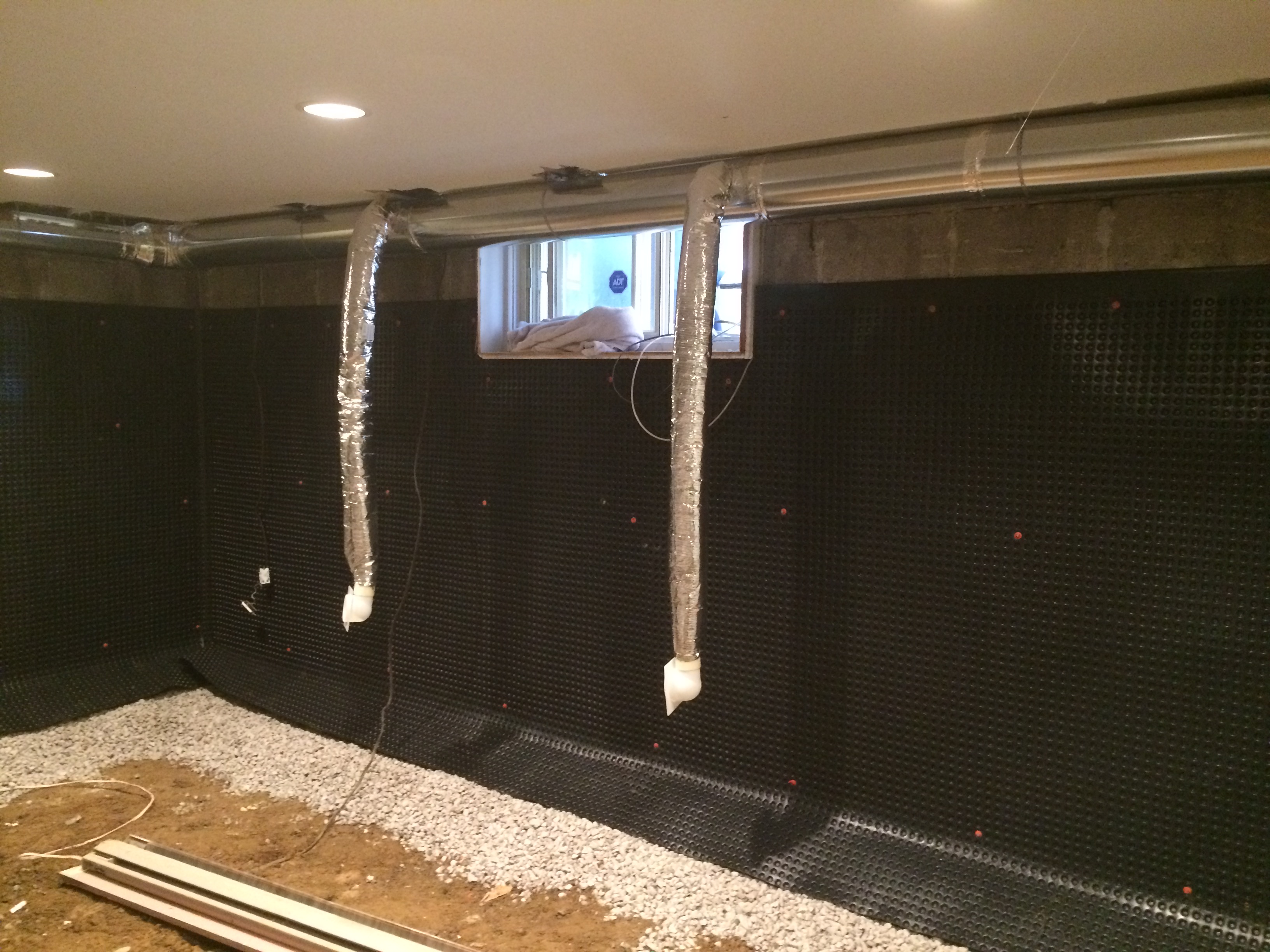
Excavating to the footing, repairing the wall, and applying membrane and drainage board keeps water out of the foundation entirely. It preserves the structural integrity of the wall and eliminates the freeze-thaw deterioration that slowly destroys concrete and block. New weeping tile at the footing carries water away instead of letting it build pressure. It is the most complete solution available.
What interior waterproofing does
An interior system does not keep water out of the wall — it manages water at the slab edge, channelling it to a sump before it reaches your floor. That distinction matters, and any contractor who blurs it is not being straight with you. Interior systems are effective, considerably less disruptive, and often the only option when the exterior wall cannot be reached: a neighbouring building, a driveway, a deck, a mature tree or a city easement.
When crack injection is enough
In poured concrete, an isolated crack with no drainage failure behind it can be sealed from inside with polyurethane or epoxy injection in a single visit. It is the cheapest correct answer when the crack is genuinely the whole problem — and the wrong answer when the weeping tile has collapsed.
The part everyone skips
Grading and downspouts. A surprising share of the wet basements we are called to inspect are caused by a downspout discharging beside the foundation or ground sloping back toward the house. Fixing that first costs very little and sometimes solves the whole problem.
Tricon Ontario Inc. provides free on-site foundation inspections. See our waterproofing services →
Winter · Roofing
Ice dams explained — and how to stop them before January
An ice dam forms when heat escaping into an attic melts snow on the upper roof, the meltwater runs down to the cold eave, and refreezes. The ridge of ice that builds up traps the next round of meltwater, which then backs up under the shingles and into the building.
Two things follow from that. First, ice dams are an insulation and ventilation problem wearing a roofing costume. Second, chipping the ice off treats the symptom while damaging the shingles underneath — which is why we do not do it that way.
The three fixes that work
Air sealing. Sealing attic bypasses — pot lights, top plates, plumbing stacks, hatches — stops warm interior air from reaching the roof deck in the first place. It is the highest-value repair of the three.
Insulation. Bringing attic insulation up to a consistent, uninterrupted depth keeps the deck cold. Patchy insulation creates warm spots and warm spots create dams.
Ventilation. Balanced soffit intake and ridge exhaust moves any residual heat out before it can melt snow. Blocked soffit vents — usually buried under insulation — are extremely common.
What to do if a dam has already formed
Steam removal, not chipping or salt. Then find where the water got in and dry the structure properly before the cavity gets a chance to grow mould.
Tricon Ontario Inc. responds to winter roof emergencies 24/7. See winter emergency services →
Building envelope · Restoration
Why caulking joints fail in two years instead of twenty
A correctly installed sealant joint on a commercial building should give fifteen to twenty years. Many give two or three. The material is almost never the reason.
Caulking over old sealant
New sealant bonds to old sealant, not to the substrate. The joint then fails at the original bond line, usually in the first freeze-thaw season. Removal has to be complete.
No backer rod, or the wrong size
Backer rod controls the depth of the joint and prevents three-sided adhesion. A joint bonded to its back cannot stretch as the building moves, so it tears. The rod must be sized to compress correctly into the joint width.
Dirty or unprimed substrate
Dust, laitance and residue prevent adhesion. Many substrates — some masonry, some coated metals — need a primer, and skipping it saves an hour and costs the whole joint.
Wrong product for the movement
Joints on precast, curtain wall and long masonry runs move considerably. A sealant rated for low movement will simply not survive the annual cycle.
Not tooling the joint
Tooling forces the sealant into contact with both faces and creates the hourglass profile that lets it stretch. An untooled bead looks fine and performs poorly.
Tricon Ontario Inc. performs building restoration and commercial caulking at any height or location. See our caulking services →
Emergency · Mould
Mould after a water loss: the 48-hour window
Mould needs three things: spores, which are already in every building; organic material, which is what drywall paper and wood are; and moisture. Remove the moisture fast enough and nothing happens. Leave it and, in typical Ontario indoor conditions, growth can begin within 24 to 48 hours.
Surface dry is not dry
Carpet can feel dry while the underpad and subfloor are saturated. Drywall can look fine while the bottom 300 mm holds water. This is why proper restoration uses moisture meters and, where needed, thermal imaging rather than judging by touch.
What real drying looks like
Air movers sized and positioned to move air across wet surfaces, dehumidifiers sized to the volume of the space, base trim or drywall removed where water is trapped in a cavity, and readings logged every day until the material reaches the dry standard for that building. Equipment comes out when the numbers say so — not on a schedule.
When remediation is needed instead
If growth has already established, drying is not enough. The area is contained under negative pressure, affected material is removed and bagged, surfaces are HEPA-vacuumed and cleaned, and the space is verified before rebuilding. Painting over mould does not remediate anything.
The part that prevents the repeat
Every mould job should end with the moisture source fixed — the leak, the failed seal, the condensation problem, the drainage. Otherwise you are scheduling the same project again in eighteen months.
Tricon Ontario Inc. handles containment, remediation and the repair that stops it recurring. See mould remediation →